29 May 2026
A hundred concrete families, one holds gold — and nobody knows which
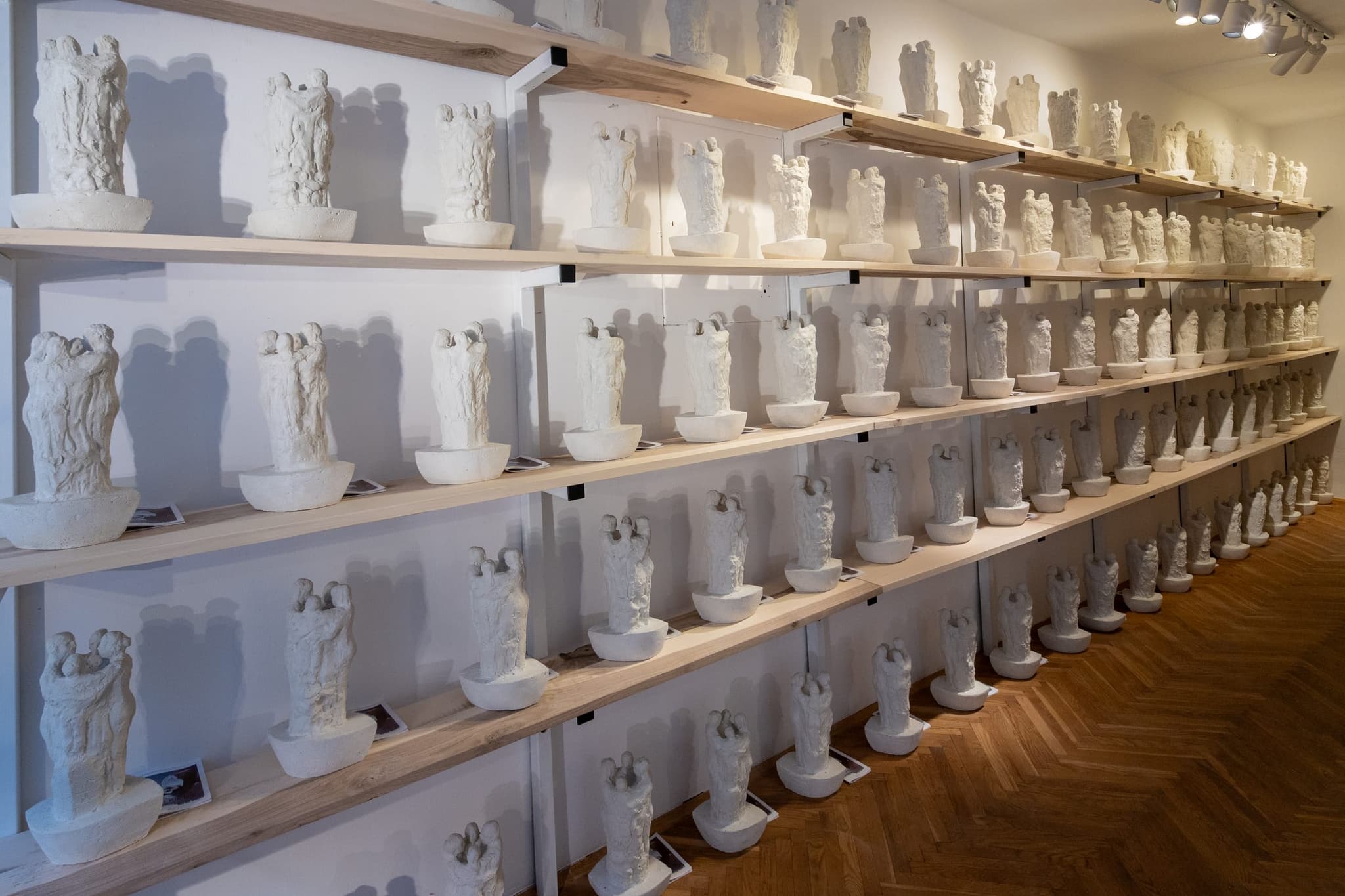
In May 2026, a hundred small concrete sculptures stood in Galerija Mulec on Trubarjeva in Ljubljana. Alike at first glance. Each one is a family: figures set in a circle, turned toward one another, planted on a small concrete boat.
Ninety-nine of them have two metres of copper wire cast inside, wound into a double helix. One has the same helix in gold. The wire goes into the mould before the pour, so nothing shows on the outside — and nobody knows which sculpture got the gold. The sculptor included.
Why two metres
Two metres is not arbitrary. It is roughly the length of the DNA coiled inside a single human cell. So what is buried in each sculpture is a gene — buried in a family, not an individual.
The pricing follows from that. The work takes its cue from George Price, the population geneticist who derived the equation for altruism: the mathematics of why family sacrifices for family. Price wrote the equation, then spent the rest of his life contending with what it implied. The sculptor calls this a Price performance. On opening night a piece cost €250, during the show €500, and after it closed €1000.
The gold is 25 grams — worth considerably more than anyone paid. Everyone knew that walking in.
A wager, not a puzzle
The catalogue places the work beside Duchamp's Monte Carlo Bond: art made as a wager. The difference is that Duchamp's bond did not have to be destroyed to find out whether you had won.
This one does. You can own a sculpture for the rest of your life and never learn what is inside it, unless you break it. The moment you do, you have your answer and no longer have the sculpture.
Most of them are now in different homes. In none of those houses does anyone know.
White as a way home
Every sculpture is white. The sculptor describes whiteness as going "home", to antiquity — which was in fact painted, though not all of it, as was the largely polychrome sculpture of the middle ages. The whiteness of the material was the choice of sculptors such as Klaus Sluter and Michelangelo: they let the material speak for itself, so they did not paint it.
Whiteness can still be provocative. "White" material as privileged material.
The casts were made with fine sand and white cement to reach a deeper white, with microfibres added for strength. Each piece weighs six to seven kilograms. The show also included larger marble works: medium ones of twenty to thirty kilograms, the largest sixty.
A hundred unique pieces that look the same
Each of the hundred is unique, however similar they appear. The sculptor made ten moulds and ten casts from each — the upper limit at which a cast still counts as an original, much as in printmaking.
Watch them for longer and a dynamic appears between the figures. Some children look up, or away; the sculptor worked from the Svetovid figure, where the gazes are directed outward. In places the surface is bubbled, which lends the pieces the patina of antiquity.
The inward gaze of the family members can be read as a suggestion that one has to know oneself inwardly — and that you do not come to know yourself in pure individualism, but only in relationships, in community, in the family you grow through.
The sculptor entered the project together with his wife Vilma Ducman, with the wider family and friends taking part.
The piece is in the works, and the exhibition is documented among the exhibitions.